
 |
As investors we are constantly battling the risk versus reward dichotomy. We want high rewards but without all the risk. It essentially comes down to the proper asset allocation and diversification that an individual has within their portfolio. When this question is argued about, it tends to circle around two types of risk: systematic risk and unsystematic risk. Here are definitions of each type of risk from Investopedia:
Systematic Risk: The risk inherent to the entire market or entire market segment. Also known as “un-diversifiable risk” or “market risk.” Interest rates, recession and wars all represent sources of systematic risk because they affect the entire market and cannot be avoided through diversification.
Unsystematic Risk: Risk that affects a very small number of assets. Sometimes referred to as specific risk. For example, news that is specific to a small number of stocks, such as a sudden strike by the employees of a company you have shares in, is considered to be an unsystematic risk. Theory suggests that unsystematic risk can be negated through diversification of assets.
As investors, the only type of risk we can attempt to overcome to some extent in our portfolios is the unsystematic risk – the risk that each individual security brings to our portfolios. There is general agreement that to overcome this unsystematic risk an investor needs to hold a certain number of companies in their portfolio. The question is how many stocks do we need to safely avoid that risk. There are two camps in this battle.
Camp 1: 15-20 Stocks Are Required
This camp says that by holding 15 – 20 stocks, you effectively overcome unsystematic risk in a portfolio. This argument was covered the best by Burton Malkiel in A Random Walk Down Wall Street
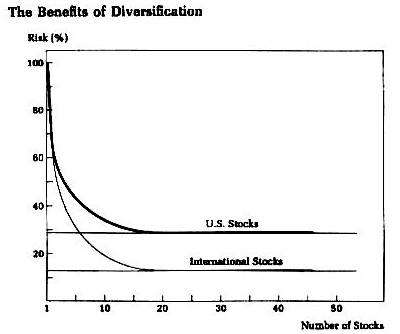
If you look closely at the chart, you can see that somewhere between the 15 – 20 stock mark, the unsystematic risk is greatly reduced and flattens out. At this point, there is no additional diversification that comes from adding more stocks to the portfolio.
Notwithstanding this chart, I have also seen research from various websites that suggests that because of low transaction costs with online brokers, an investor can purchase around 50 stocks to help with risk. I think this is primarily driven by the fact that many investors have difficulty building truly diversified portfolios that you want to hedge your bets by buying more rather than less. Trouble is, who has the time to keep track of 50 stocks – I know I don’t.
The difficulty in building a diversified portfolio is really the main issue with the 15 – 20 stocks theory. That is where the next camp comes into play.
Camp 2: 15-20 Stocks in Not Enough
In an article by William J. Bernstein, he concludes that the 15 stock model is flawed because the overall returns of the market were driven by a few superstocks – your chances of finding these and buying them at the right time are not good:
…a grossly disproportionate fraction of the total return came from a very few “superstocks” like Dell Computer, which increased in value over 550 times. If you didn’t have one of the half-dozen or so of these in your portfolio, then you badly lagged the market. (The odds of owing one of the 10 superstocks are approximately one in six.)
His conclusion, and many other folks on the web is that an investor is better off buying the whole market through index funds than building a portfolio of 15 – 20 individual stocks.
What Am I Going to Do?
As you know, I personally own individual stocks and that is not going to change. I love doing it too much! I also own index funds and I don’t think there is anything wrong with doing both. It does spread my risk out a bit more but I do realize I do have more risk, especially with my over-exposure to banking right now. I do realize that I need to get closer to 20 stocks in and I will work on this as soon as my global allocation is brought more in line with where I beleive it needs to be (30% of my portfolio).
(Photo Credit: Marja Flick-Buijs)








If you have the time and desire to manage individual stocks (which you do), I absolutely believe you will beat the market and do better than a collection of index funds. That’s the point of individual stocks- more risk for more reward. When selected wisely of course…for the people without the time or desire, funds are the way to go.
Hi, I read your blog and got very interested. I am a new investor and thinking about investing in some stable dividend companies. Suppose i have $20k – $30k to start, what is your suggestions to put in my portfolio? And which broker account is the best? I am very interested to know your opinions. Thank you very much! (You can reply to my email as well.) Have a good day.
HI Beginner,
I am going to write a post answering your questions next week – I will email you when I plan to post it – it should help provide you with some direction.
Thanks,
The Dividend Guy
Thanks, Dividend Guy. Cannot wait to see your new post. Have a good weekend.