
This is a guest post from Dividend Growth Investor. Dividendgrowth has been investing in stocks, options, futures, forex and bonds for the past thirteen year. He has been focusing his attention particularly to companies that pay regular dividends to their shareholders since 2003. In his blog he shares his journey on his quest for achieving a sizeable passive income stream that would be realized by investing in dividend paying stocks that have consistently increased their payments over time. He hopes that his blog will serve as an inspiration for his readers and that it would change their financial lives for the better. Dividendgrowth is currently working towards achieving his CPA license, while working at a major US telecom company.
Selling Covered Calls is a strategy in which an investor sells a call option contract while at the same time owning an equivalent number of shares in the underlying stock. It is considered to be one of the safest option strategies in the market. Typically it is performed over a short term period of time, since option contracts always have a finite lifespan. The typical strike price at which call options are sold is normally above the current price at which the stock is trading. Thus, if Pepsi stock is trading at 70, its shareholders could sell a covered call at $75 strike.
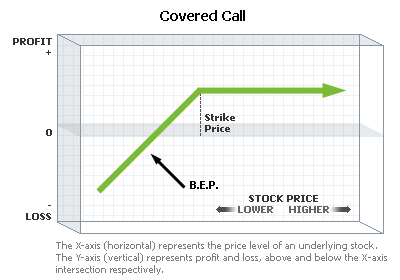 Click to Enlarge
The economic incentive for the seller for writing a covered call is that he collects options premium, which increases his income from the stock he owns. With the passage of time, the time value portion of the option’s premium generally decreases – a positive effect for an investor with a short option position. In addition to that, the stockholder still owns the stock after he writes a call. So they continue to collect all dividends paid as long as the option is not exercised!
This strategy is most profitable when stocks trade in a range and as a result the call option expires worthless. Thus an investor who can correctly predict that a stock would not experience significant price swings over a certain period in the future, could achieve extraordinary results over time. Investors are also always free to purchase the covered call back from the market at any time if they change their opinion on the direction of the stock price. Even if stock prices decline after a covered call has been written, the investor is still better off, because their losses are smaller due to the options premium collected. If the option expires worthless or is sold profitably and the investor still owns the underlying, they can generate more income by selling more covered calls.
Selling Covered Calls sounds appealing at first, because theoretically one could get two passive income streams from one stock. There are some risks with this strategy though, which might make it less appealing to investors.
First, if the stock price rises above the strike price at which the call was written, one would not be able to participate in any upside gains in the stock, because they are required to sell it to the call buyer to whom the call option was written in the first place. The only scenario in which the investor will keep the stock and the premium is when the stock price does not increase above their strike price. This strategy seems inferior because it assumes that investors could time the market by betting whether or not the stock would be above/below the strike price at expiration. Studies have shown that investors are pretty bad at timing the markets, because the majority always seems to be selling at the bottom and buying at the top. The strategy also seems inferior because by writing covered calls stockholders are limiting their upside potential, while leaving their downside wide open. You are selling your rising stocks and keeping your losers, while earning some income in the process, which in reality is eroding your capital gains. The psychological weak points of this strategy is that most investors always believe that their stocks would be rising over time, so betting against your own portfolio in terms of covered call selling seems counterintuitive. It also does not eliminate the risk of stock ownership – if a stock declines, investors will still suffer losses, although they would be a little lower due to the premium received.
Another negative for owners of dividend stocks who sell covered calls on their holdings, is that there is always the possibility that the call holder might want to capture the stock’s dividend. In that case, the option must be exercised a day before the underlying stock’s ex-dividend date. That’s the only way for the call holder to purchase underlying shares and be eligible for the dividend. In this case, you might not receive notification that the option has been exercised until the ex-dividend date itself.
In conclusion selling covered calls on dividend stocks could theoretically provide an investor with two potential streams of income from one stock if its price does not increase above their strike price – options premium collected and dividends payments received. If the price increases, the call option will be exercised and the investor must sell his stock at a predetermined price. They won’t be able to participate in the stocks upside, unless they buy their stock back, at higher levels. Furthermore the strategy does not protect against declines in prices of the underlying. Just like any strategy involving securities there is always the opportunity for a huge profit if done correctly, or for a huge loss if done incorrectly. Thus an investor will always be better off in the long run if they took those strategies with a grain of salt and do their own due diligence before taking any action, which could impact their finances.







you pointed two risks in covered call writing: one I agree with and the other is irrelevant.
The irrelevant risk is protecting to the downside. in this scenario it does not matter either way because the owner of the stock is exposed to the risk regardless if he wrote an option or not. Actually the writer of the option will fare better as he has reduce his cost base.
I generally use the covered call strategy in my “dividend” portfolio by writing calls 6 months out and 20-25% out of the money. While I do not get the same premium for doing so, in the event I am called out at the end of the 6 months, I can generally expect something in the 30% range for a 6 month holding period. If only all my investments returned that much. On the downside, there is generally enough juice in the 6 month call to give me a buck or so worth of downside protection.
Sami,
In my opinion, if I didn’t expect my stock to increase over a certain period of time or I expected it to decline, I wouldn’t sell a covered call. I would sell the stock instead or sell a naked call.
45free,
I don’t think that the risk of missing a huge move in your stocks (above the 25-30% gain that you might get if your options are exercised) is worth the miniscule gain that you obtain for the risk that you are taking. I believe that covered calls are a way for investors to cut their winners and let their losers run.
For example if we look at PEP, it closed @ 71.51 today. Its July 2008 85 call could be sold @ $0.45, which is about 0.60%. So theoretically you could do this strategy twice per year. (since you have a 6 month horizon).
If the stock goes to 90, you miss the last 5 dollars of the gain. You get compensated 45 cents for that. If it stays flat you make the most money – since you collect dividends + options premium.
If it goes down, you are “better off” than a simple buy and hold guy like me by 0.45 cents per contract – trading fees.
My dislike for covered calls generally is that if I expect the stock to go down or sit sideways, I would simply get out of the stock and purchase another one.
In addition you will need to be able to accurately forecast if the volatility of the stock would expand or contract, and how this would affect the price of the options.
This is of course my personal opinion. I could see that statistically you could come out slightly ahead if you can correctly predict that the stock does not increase a lot and that volatility does not increase a lot as well.
Good luck to everyone. The market is so large that there are strategies for all kinds of investors.
Hi
this is Amit from new delhi India
now just see how high the premiums are here/………..
a finance stock trading at INR 116
strike price 130 sold at 8.3
thats like strike price 8-9% away from cmp and premium is nearly 5 % and yes option duration is just 4 weeks i.e. next month only……….
what would be your opinion is such a scenario……………
I’ve been writing covered calls for some time now. Your statement about missing out on upside potential is incorrect. Using simple procedures of rolling an option either out or out and up as well as buying a call back pretty much mitigates that risk. It all depends on the numbers. The same can be said for a stock declining in value. As long as the company does not go bankrupt I will continue to make money for the simple fact of owning the stock.
I’m using a covered call strategy. I agree with the previous comment about enjoying the upside. You can buy the call option back and sell the stock to take some of the gain. You can also protect the downside by buying a put option valid for several months.
Great article
Hello, thank you very much for your great post. Absolutely your post is very usefull to me. Thanks.
Need Information about forex?? Just visit Forex Knowledge and Forex Strategy. This site will give you information all about forex, forex strategy, forex profit strategy, forex ebook, forex tutorial. This site guarantees your profit will indrese in short time.
Forex knowledge and forex strategy blog’s
http://forex-knowledge-strategy.blogspot.com/
If you’re interested in covered calls you may want to check out My Covered Call Blog.
If you’re interested in covered calls you may want to check out My Covered Call Blog.
I agree with dividend gowth investor. I tried covered alls for 2 years and found that I wasnt getting anywhere fast. The steep declines is where I got caught out and rolling down wasnt enough. Then it would take months of writing to get back to even again. Yes you are reducing your ownership cst of the stock but your portfolio value is not up. You are better of doing spreads out of the money with leaps instead of covered calls. On dividend capture I would suggest writing leaps on high dividend stocks deep in the money. You get higher leverage and downside protection as well as the dividend
Good Luck
Your article is excellent and offers a very good outline of the risks of covered call writing. I have been doing covered calls since options were extended to many stocks back in the 1970’s. I have never had a stock underperform because of covered call writing. A lot depends on the investor. I live in Canada and in our country retirement accounts are strictly regulated. An investor can buy stocks and securities but they can only sell covered calls against them. We are not allowed to sell naked or cash secured puts. This forced me years ago to examine covered call writing strategies as I needed my portfolio to grow at least 12% every year. While I love naked puts I have developed many strategies over years of doing covered calls in my retirement account that provide excellent returns and at the same time offer some protection for downside movement. I believe a well constructed covered call portfolio will outperform buy and hold. While many buy and hold investors are content to reinvest the dividends from dividend paying stocks, I am collecting through covered call writing, small option premiums every month or two on my favorite stocks and I can reinvest that money back into the stock (or other stocks) at a much quicker pace. The risk of a covered call writing strategy is not putting in place clear goals and objectives prior to establishing positions. Without clear goals and objectives an investor, new to covered calls, will be upset to see a stock shoot past their strike point, and often will purchase the covered call back, creating a loss on the call sold, and then watch the stock pull back adding to his loss. This is not the way to handle covered calls. If an investor is new to a strategy they should paper trade for many months, study other covered call writing strategies and learn how to handle stock movements; when to buy back their position; when to let the dividend be called with the covered call; when to roll up; when to add to their position. The one thing that a covered call writing portfolio does is provide not just a steady income stream, but forces the investor to take profits along the way and then reinvest back either into the same stock or a new stock. If a covered call trade can provide a return of just 12% a year, every year, they will far surpass any buy and hold trader over years of investing. Those who fail at covered call writing are those who have not put together an iron clad strategy, are not completely sold on the concept of covered call writing and therefore fluctuate between buy and hold and covered call writing. The successful covered call writer is a trader who has established clear goals and objectives and understand that over time they will surpass the buy and hold strategy. I have posted many trades on my website http://www.fullyinformed.com of real trades being done presently as well as past trades to show the types of returns available. Go to my section on the retirement accounts where I can only do covered call writing because of Canadian Laws. You can see that even when stocks shoot up, there are many strategies available that will continue to outperform buy and hold investors. Over the long run, covered call writing provides income, capital gains and limited protection from downside action. For myself, when that downside comes I have built up a nice cash base to jump in and buy my favorite stocks at discount prices. There are many benefits to covered call writing, but goals and objectives have to be established to reap the true reward of covered call investing. When an investor realizes this they will benefit greatly from a covered call writing strategy and will look forward to their favorite stock going on sale in a major downturn such as we saw in late 2008 and early 2009.
I tried covered calls but found the movement to be slow. It’s safe but i think we are all looking for something with more of an upside.